Anthropic’s New Enterprise Analytics Suite Solidifies Claude Code’s Market Lead Amid Booming Agentic AI Coding Demand
The internal financial performance metrics Anthropic shared with investors this week confirm a key milestone for the frontier AI lab: its flagship AI coding tool Claude Code has delivered exactly the breakout commercial success the company targeted from launch.
The firm posted operating profitability in the second quarter of this year, paired with an extraordinary 900% net revenue retention rate — meaning existing Q3 2025 enterprise customers scaled their total spending on Anthropic’s platform ninefold by the same quarter in 2026. That explosive growth among its existing user base underscores Anthropic’s years-long focus on driving long-term enterprise loyalty, a strategy it expanded on this Wednesday with the launch of a full new suite of reporting tools built to give clients granular, line-item visibility into exactly what value they generate from every token they purchase.
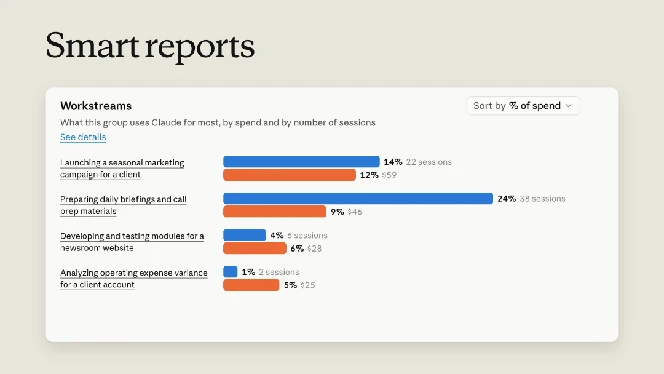
Pulling together internal platform analytics and anonymized employee workflow survey data, team managers can now map their entire team’s AI coding activity across any custom date range: review finished outputs the group built with Claude Code, calculate total associated spend, and pinpoint bottlenecks where AI-assisted workflows broke down and wasted resources. Anthropic has explicitly confirmed this end-user usage data will not be tapped for default model training, addressing a top longstanding enterprise data privacy concern, and the platform will also auto-generate actionable recommendations to help teams boost their Claude Code ROI over time. Anthropic is also rolling out shared pooled group budget controls alongside the reporting suite, to make it far easier for cross-functional engineering teams to coordinate and cap overall token spending.
This feature set directly targets one of the most pressing unmet pain points for large enterprise AI buyers: most major businesses have been scrambling to quantify returns on their fast-growing AI tooling budgets, as the vast majority of Fortune 500 firms still have not seen measurable, top-line gains from mass AI deployment, even as venture-backed startups pour increasing sums into token consumption.
New data released yesterday by developer workflow platform Jellyfish underscores exactly why this new reporting layer is so timely. Analyzing anonymized agentic coding tool usage from 276,000 of its software engineer customers, Jellyfish’s latest industry report found that Claude Code and other coding tools built on Anthropic’s models remain the most widely adopted in the space, accounting for nearly 1 in 3 of all code change submissions sent for peer review. Even more notably, enterprise spending on these Anthropic-powered coding tools has skyrocketed 10x since the start of 2026, and now makes up roughly 2% of total company engineering budgets.
“Even if that 2% share seems small on the surface, that 10x year-to-date growth is far beyond what almost every CFO budgeted for at the start of the year,” Jellyfish chief scientist Nicholas Arcolano told TechCrunch. “We’ve clearly hit an inflection point where teams realize just dumping more money on AI access isn’t enough — you have to actively optimize that spend, and make the tool work for your specific workflows.” Anthropic’s new reporting suite is purpose-built to solve that exact optimization challenge.
Right now, Anthropic holds a clear lead in the enterprise agentic coding space, but the exact factors that create long-term user stickiness for these tools are far from obvious. Many industry observers predicted the summer launch of OpenAI’s Astra coding model would eat heavily into Anthropic’s market share, but adoption numbers to date show no sign of that slowdown playing out.
“It took months and months before we saw OpenAI’s original Codex register as a blip in our usage data, and we’re only just now seeing a small uptick tied to Astra,” Nikolas Albarran, AI product lead at Jellyfish, told TechCrunch. He noted that public discourse on platforms like X paints a far more competitive picture, where Silicon Valley insiders constantly claim “Codex is the clear better option.” In practice, though, “Anthropic already had a massive head start with polished, enterprise-focused sales motions, and a huge installed base of existing users. Their tools just worked reliably out of the gate, so most teams already put months of engineering work into standardizing their internal coding workflows around Claude Code. There’s no big enough pain point to justify switching right now.”
This lock-in effect isn’t just about custom workflows and familiarity, either. The structural realities of B2B enterprise sales mean that once a frontier AI provider integrates its tools deep into a large organization’s stack, switching costs are exponentially higher than they are for individual freelance programmers or small startups. Albarran points to the massive investments all top AI labs are making in Forward Deployed Engineering (FDE) teams — dedicated groups of AI consultants that embed directly inside client organizations to help build custom use cases and roll out tools at scale. Anthropic’s new reporting suite effectively acts as a low-cost, self-serve “FDE-lite” offering that delivers many of those optimization benefits to thousands of smaller enterprise clients that couldn’t access dedicated in-person consultant support before.
“We’re at the point where these tools are mature enough that once you’ve put in the work to integrate them across your team, switching gets harder every quarter,” Albarran explained. “Even if most of these competing models perform nearly the same on paper, they all have tiny, idiosyncratic quirks — from how they handle agent.md configuration files to how they tie into your existing internal CI/CD pipelines — that mean the cost to switch providers is never anywhere close to zero.”
Anthropic’s New Enterprise Analytics Suite Solidifies Claude Code’s Market Lead Amid Booming Agentic AI Coding Demand