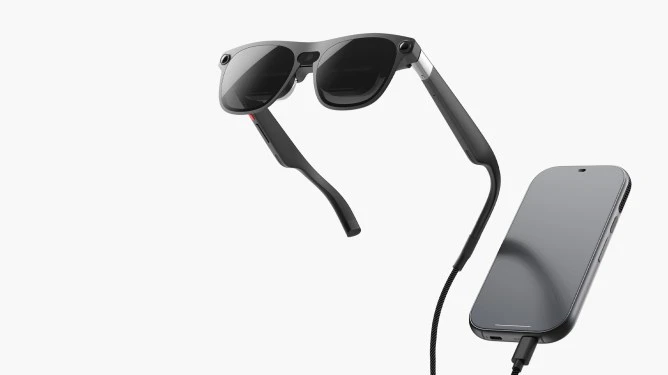
Xreal Unveils Android XR-Powered Aura Wired Smart Glasses at 2024 Android Dev Summit, Escalating Spatial Wearable Competition
At Wednesday’s Android Dev Summit, Google’s official smart glass hardware partner Xreal officially debuted its new Xreal Aura wired smart glasses, built natively on Google’s Android XR operating system and Qualcomm’s top-tier Snapdragon Reality Elite spatial processing platform. Both brands first gave the public an early preview of the upcoming wearable earlier this year at Google’s annual I/O developer conference.
As Meta ramps up its investment and rollout of consumer-facing smart glasses, competing tech giants including Apple and Google are racing to launch their own competing spatial wearable lines. Echoing the open, partner-led strategy that made Android the world’s dominant smartphone operating system, Google is leaning on a diverse ecosystem of collaborators — spanning Samsung and Xreal, among other manufacturers — to bring Android XR-powered devices directly to consumers, rather than developing and selling first-party branded hardware itself.
Unlike fully self-contained standalone AR/VR headsets that house all processing components in their frames, the new Xreal Aura offloads all heavy computational work to a portable puck-sized companion device, before rendering content directly into the wearer’s field of view. Its overall form factor is far closer to Meta’s slim, everyday-friendly smart glasses than the bulky, fully immersive Apple Vision Pro headset.
For core display specs, the Aura uses Sony’s premium Micro-OLED panels to deliver 1200p resolution at a 120Hz refresh rate and a 95-degree field of view — on paper, these specifications outperform the display configuration featured on the latest Ray-Ban Meta smart glasses. The tradeoff for that higher performance comes in extra weight: the Xreal glasses tip the scales at 95 grams, compared to Meta’s 69g frames, and users will need to carry the separate processing puck alongside the glasses to make the device function.
At launch, the Aura supports thousands of popular Google Play apps and games, alongside a curated library of exclusive Android XR-native experiences. Highlighted offerings include the Android XR NBA App, custom Nevatars spatial avatars, Fallout: Factions, the space-themed Project Hail Mary: Journey Among the Stars, the official NASCAR XR App, and the San Francisco Ballet Company’s spatial adaptation of The Nutcracker. Users can also plug a desktop computer or handheld gaming console directly into the glasses via USB-C to use them as a high-resolution extended augmented display, with support for custom multi-virtual-monitor setups or a single giant floating screen that works seamlessly for both productivity workflows and media consumption. For audio performance, Xreal integrated Bose’s proprietary sound tuning technology to deliver crisp, immersive audio while users watch videos or listen to music. As a native Android XR device, the Aura also gives users full access to Google’s Gemini AI assistant, which can answer natural language questions and pull context directly from content displayed in the user’s field of view for more relevant, targeted support.
Pre-orders for the Xreal Aura open starting today across the U.S., Canada, Japan and South Korea. The base 12GB RAM + 256GB storage configuration has a standard retail price of $1,279, with a limited-time launch discount that drops the cost to $1,099 through the end of December. The higher-tier 16GB RAM + 512GB model retails for $1,499, and is available for a promotional $1,299 during the same launch window. Xreal has confirmed all pre-orders will begin shipping to customers by mid-November.
Back in May, Xreal CEO Chi Xu told TechCrunch that building a sustainable, profitable smart glasses business remains a major industry challenge, noting that every current player in the space is operating at a loss. He added that the Aura line was built to support a far wider range of real-world use cases than prior generations of smart glasses, and that the entire wearable industry had hit a critical inflection point, where hardware, software and design have finally matured enough to enable mass market adoption.
“You need all the key pieces of the puzzle to be ready at the same time — the hardware has to be polished, the operating system has to be fully stable, and then you need a great, intuitive user interface that people will actually want to use on a daily basis,” Xu said at the time.
Xreal Unveils Android XR-Powered Aura Wired Smart Glasses at 2024 Android Dev Summit, Escalating Spatial Wearable Competition